30% Off New Customer Subscription^ With Code: SAVE30
30% Off New Customer Subscription^ With Code: SAVE30
Tried Everything For Your Baby's Skin?
Cut out dairy. Switched to free and clear. Tried every gentle cream in the aisle?
You're not missing something obvious. You may just be looking in the wrong place.
For a lot of babies, what shows up on the outside actually starts on the inside - in the gut.
The bacteria doing the heavy lifting
Meet Bifidobacterium

These are the good gut bacteria your baby was meant to have in their gut.
In the earliest weeks and months of life, they help teach the immune system what to react to and what to leave alone. That early lesson matters more than most people realize.
When the right bacteria are present, the immune system learns balance. When key bacteria are missing, it can get jumpy, flagging harmless things as threats.
The skin³,⁴. Research has consistently linked the presence of Bifidobacterium in early infancy to healthier immune development and to lower rates of certain atopic skin conditions later in life³,⁴,⁸.

When present these good bacteria:

Produce compounds that support a healthy gut environment⁵,⁶
Keep less-helpful bacteria in check⁷
Actively shape a healthy ecosystem around them
The stat that stops parents in their tracks
Most babies born in the U.S. today aren't starting out with the bacteria they were meant to have

9/10
U.S. infants were missing at least one critical strain of Bifidobacterium**.

1/4
U.S. infants had no detectable Bifidobacterium at all**.

Pediatrician Recommended
"I recommend infant-specific probiotics like Persephone's synbiotic, which is designed to restore what nature intended every baby to have in those critical first months of life."
— Dr. Tanya Altman, MD, Pediatrician and Best-Selling Author
Persephone is not just a probiotic. It’s a synbiotic.
It’s a combination of probiotics (beneficial bacteria) and prebiotics (their food) designed to work together for greater impact.


4
Keystone Strains
proprietary infant specific probiotics
HMO
Prebiotic Blend
the exact fuel the probiotics need to do their job
90
Day Peace of Mind Promise
We stand behind our product If you’re not satisfied for any reason, just reach out and we’ll make it right.
FAQs
We stand behind our product with a 90-day Peace of Mind Promise. If you’re not satisfied for any reason, just reach out to our Care Team.
Every baby is different. Some parents notice changes in digestion and comfort within the first few weeks. Immune and long-term benefits build over months of consistent use. That's why we offer a 90-day guarantee. Meaningful gut health takes time, and we want you to have the space to see it work.
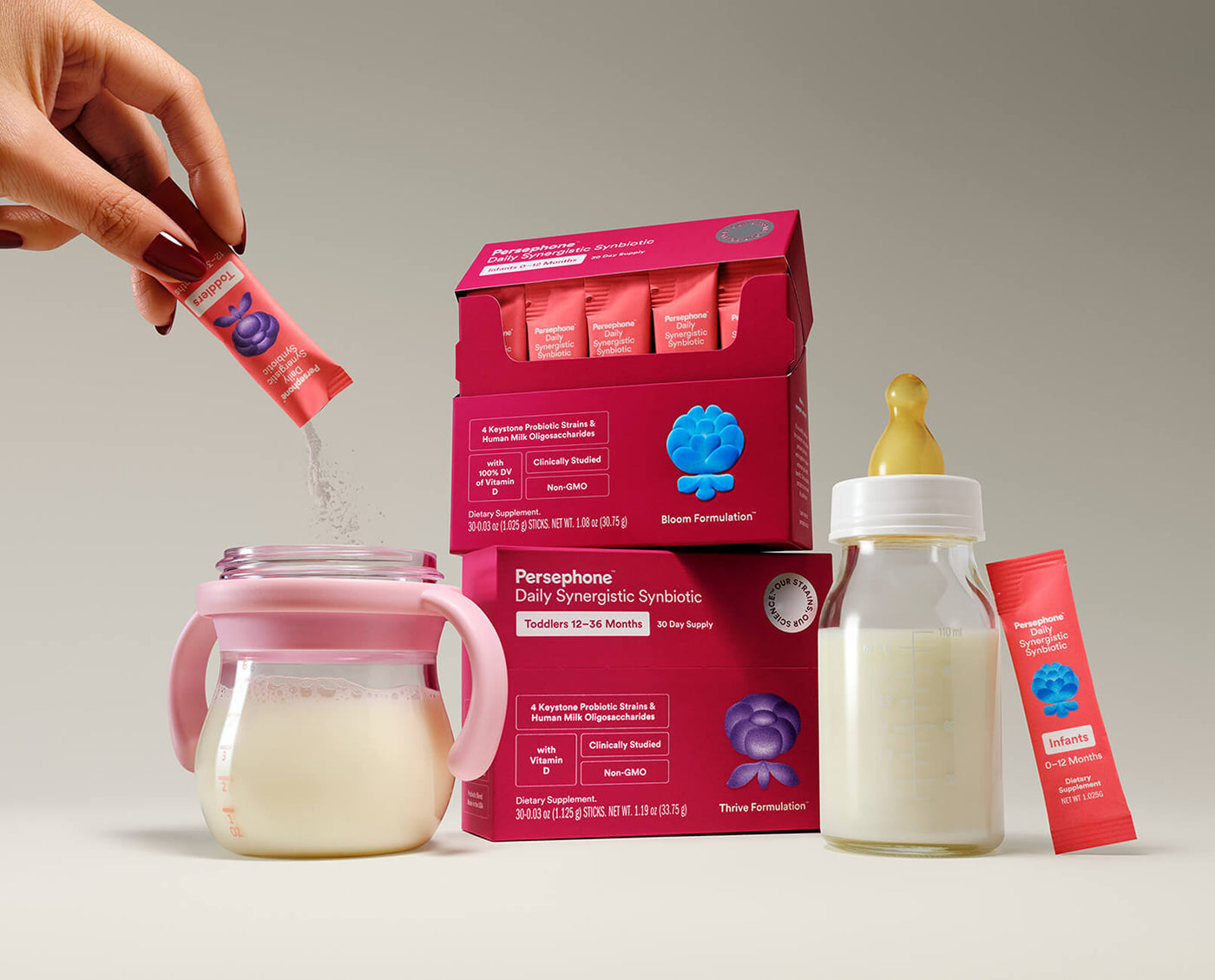
Yes. Both Bloom and Thrive are designed specifically for infants and toddlers, third-party tested at Eurofins for heavy metals, allergens, and contaminants, and certified by the Clean Label Project's First 1,000 Days Promise.
Yes. Mix one packet into a single daily bottle of formula.
Pro Tip: Mix it into a smaller bottle or portion so you know your baby finishes the full serving.
Most likely, yes. B. infantis has been declining in the Western gut for over 50 years — a multigenerational shift that predates your own mother's birth. Even the most health-conscious pregnancy can't fully reverse a trend that has been building for generations. Our My Baby Biome study found 9 in 10 babies missing B. infantis regardless of feeding method or birth type.
Absolutely. 7+ years of research on this specific product plus many additional years on the microbiome. We also test every batch with a 3rd party.
Citations & References
- Salem, I., Ramser, A., Isham, N., & Ghannoum, M. A. (2018). The gut microbiome as a major regulator of the gut-skin axis. Frontiers in Microbiology, 9, 1459. https://doi.org/10.3389/fmicb.2018.01459
- Henrick, B. M., et al. (2021). Bifidobacteria-mediated immune system imprinting early in life. Cell, 184(15), 3884–3898. https://doi.org/10.1016/j.cell.2021.05.030
- Donald, K., & Finlay, B. B. (2023). Early-life interactions between the microbiota and immune system: impact on immune system development and atopic disease. Nature Reviews Immunology, 23, 735–748. https://doi.org/10.1038/s41577-023-00877-7
- Hoskinson, C., et al. (2023). Delayed gut microbiota maturation in the first year of life is a hallmark of pediatric allergic disease. Nature Communications, 14, 4785. https://doi.org/10.1038/s41467-023-40495-6
- Laursen, M. F., et al. (2021). Bifidobacterium species associated with breastfeeding produce aromatic lactic acids in the infant gut. Nature Microbiology, 6, 1367–1382. https://doi.org/10.1038/s41564-021-00970-4
- Meng, D., et al. (2020). Indole-3-lactic acid, a metabolite of tryptophan, secreted by Bifidobacterium longum subspecies infantis is anti-inflammatory in the immature intestine. Pediatric Research, 88, 209–217. https://doi.org/10.1038/s41390-020-0926-5
- Duar, R. M., Kyle, D., & Casaburi, G. (2020). Colonization resistance in the infant gut: the role of B. infantis in reducing pH and preventing pathogen growth. High-Throughput, 9(1), 7. https://doi.org/10.3390/ht9010007
- Bokulich, N. A., et al. (2016). Antibiotics, birth mode, and diet shape microbiome maturation during early life. Science Translational Medicine, 8(343), 343ra82. https://doi.org/10.1126/scitranslmed.aad7121
- Hill, D. A., & Spergel, J. M. (2018). The atopic march. Annals of Allergy, Asthma and Immunology, 120(2), 131–137. https://doi.org/10.1016/j.anai.2017.10.037